
Ubiquitin & Ubiquitin Chains
Advanced solutions for Ubiquitin Proteasome System research
Need Help?

- Overview
Ubiquitin is a small, highly conserved regulatory polypeptide (76-amino acids and 8.6kDa) found ubiquitously in most tissues of eukaryotic organisms. In the ubiquitination pathway, the conjugation of the C-terminus of ubiquitin to an ε-amino group of lysine on a target protein, can be key to decrypting cellular signaling pathways.
Conjugation events from either a single ubiquitin to a target protein (monoubiquitylation) or a chain of ubiquitins (polyubiquitylation), have diverse functions. Polyubiquitylation utilizing any of the seven lysine residues (K6, K11, K27, K29, K33, K48, K63), can govern a variety of biological processes ranging from proteolysis to DNA damage response.
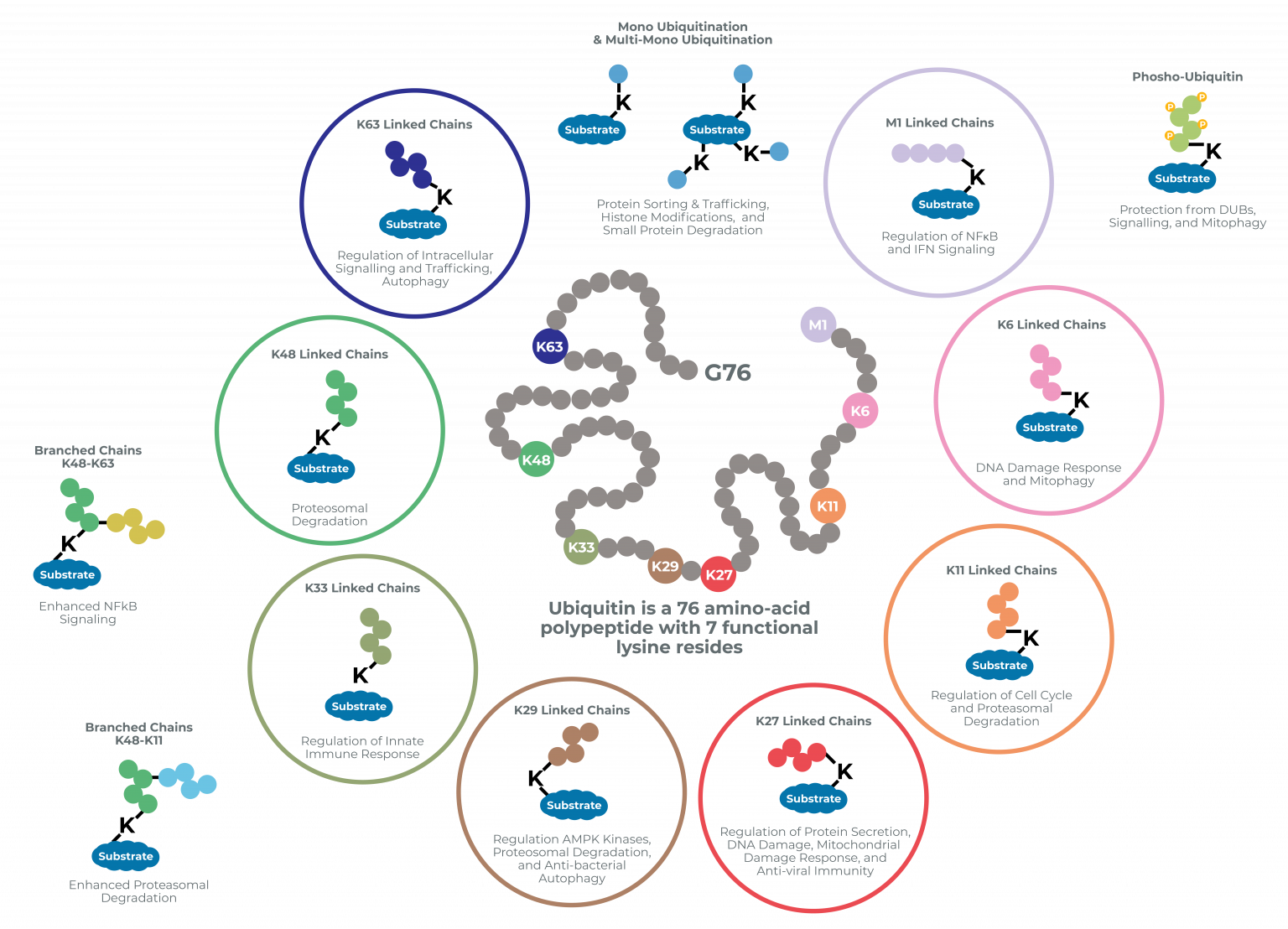
Enzymatic conjugation of ubiquitin is performed by a series of enzymes — ubiquitin activating enzyme E1, ubiquitin conjugating enzyme E2, and ubiquitin ligase E3. Ubiquitylation of proteins is reversible in cells; both mono- and polyubiquitylated chains are cleaved by hydrolysis catalyzed by deubiquitylases (DUBs).
- Lysine Residues
- LifeSensors Solutions
LifeSensors has been at the forefront of developing innovative solutions for drug discovery related to the Ubiquitin Proteasome System (UPS). We offer a large collection of UPS related tools with a multitude of ubiquitin enzymes, chains, and assays to assist you in your research.
UbiProbe
A 384-well TR-FRET assay for evaluating the cleavage of new DUBs
CHOP
A deubiquitination assay to test ubiquitin cleavage by an isopeptidase
~35 DUBs
Deubiquitylases for comprehensive studies
- UbiProbe 384-well TR-FRET
Next Generation High-Throughput Screening
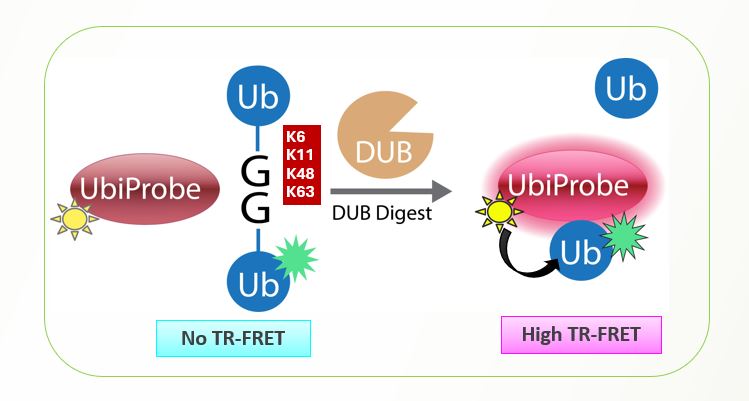
LifeSensors’ diubiquitin substrates represent a new class of substrates for the continuous fluorescent measurement of true isopeptidase activity. The IQF assay is expensive to run, requiring multiple different variations of IQF in order to properly screen for linkage-specific DUB activity.
The UbiProbe platform is designed to be a cost-conscious, comprehensive platform for easier DUB screening. The platform allows users to avoid the specific assay requirements of IQF screening, while also addressing manufacturing and background concerns sometimes associated with the IQF assay.
Service Highlights
Not only limited to linkage 48 or linkage 63 screening, the UbiProbe assay can also be used for K6, K11, K27, and K29 screening allowing a reliable assay for studying DUB cleavage in a consistent methodology.
Service Highlights
- Superior to Ub-AMC and CHOP Assays
- Greater dynamic range
- Amenable to high-throughput screening (HTS) and miniaturization
- Less compound interference
- Less signal-to-background
- CHOP Assay
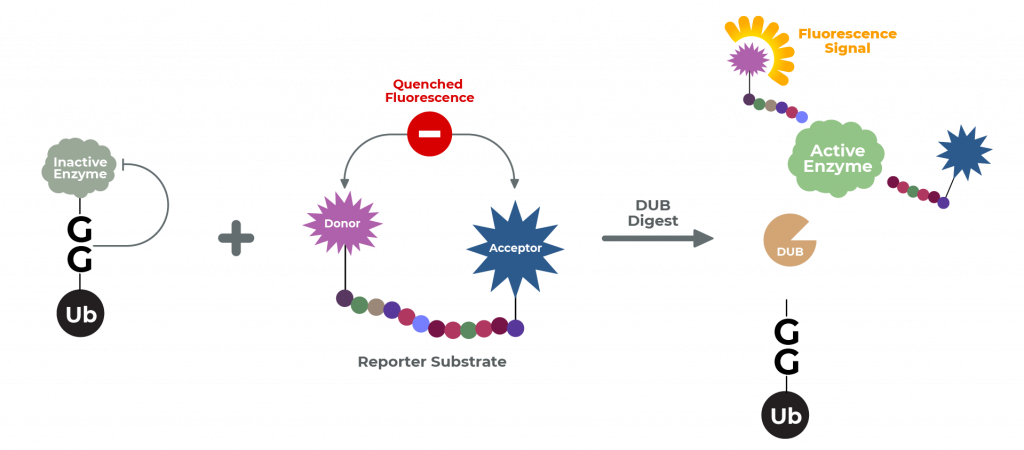
The Ub-CHOP2 Reporter Deubiquitination Assay consists of ubiquitin fused to a reporter enzyme, as well as a separate reagent substrate for the reporter enzyme. When fused to ubiquitin, the reporter is rendered catalytically inactive. Following cleavage of the Ub-reporter system by the isopeptidase, the free (and now active) reporter subsequently acts upon its substrate.
Thus, in this coupled assay, the signal generated by cleavage of the reporter enzyme’s substrate is a quantitative measure of isopeptidase activity. This assay utilizes the two classes of ubiquitin: ubiquitin-like proteins (UBL) and ubiquitin-domain proteins (UDP).
The UBLs function as modifiers in a manner analogous to that of ubiquitin. Examples consist of (and are available for this assay) SUMO, Nedd8 (aka Rub1), ISG15, Apg8, APg12, and Fat10. The ubiquitin-domain proteins consist of parkin, RAD23, and DSK2.
Service Highlights
- Superior to Ub-AMC and FRET-based assays
- Rapid and robust readout for DUB activity within 45 minutes with non-radioactive reporter substrates
- Amenable to high-throughput screening (HTS) and miniaturization
- Assay tests deconjugation of ubiquitin/UBL from a more physiologically relevant protein
- Unlike Ub-AMC, the CHOP2 Reporter system does not require excitation in the UV range (reducing the incidence of false-positives)
- Key Advantages
- UbiProbe assays to monitor all types of isopeptide chain linkage and DUBs
- Selective ubiquitin chains for DUB specificity
- Native and phospho-polyubiquitin chains, selective and wild-type
- Related Products
- Ubiquitin & Ubiquitin Chains
Product / Tools Name
SKU
Categories
Add to cart
- DUBs