
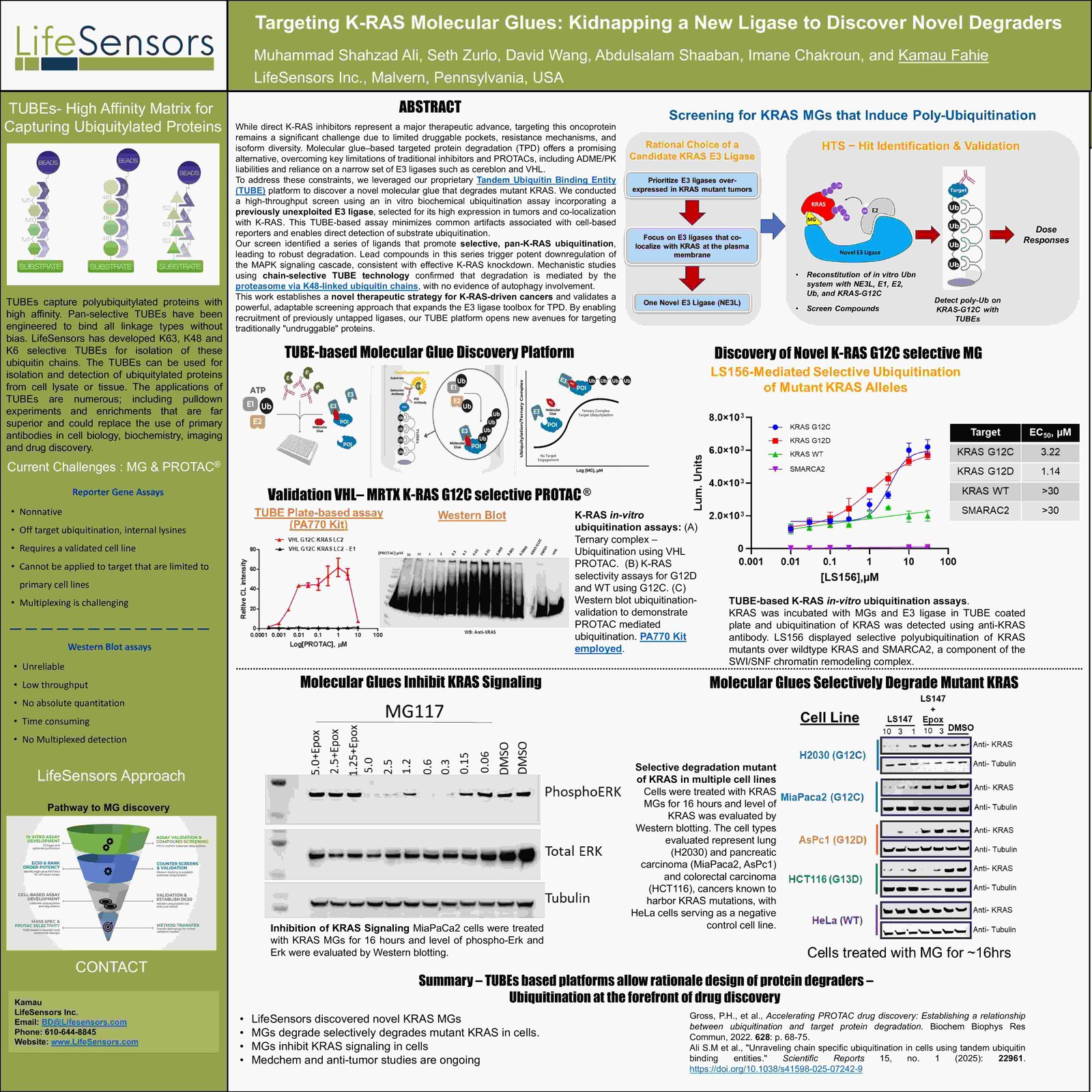
While direct K-RAS inhibitors represent a major therapeutic advance, targeting this oncoprotein remains a significant challenge due to limited druggable pockets, resistance mechanisms, and isoform diversity. Molecular glue–based targeted protein degradation (TPD) offers a promising alternative, overcoming key limitations of traditional inhibitors and PROTACs, including ADME/PK liabilities and reliance on a narrow set of E3 ligases such as cereblon and VHL.
To address these constraints, we leveraged our proprietary Tandem Ubiquitin Binding Entity (TUBE) platform to discover a novel molecular glue that degrades mutant KRAS. We conducted a high-throughput screen using an in vitro biochemical ubiquitination assay incorporating a previously unexploited E3 ligase, selected for its high expression in tumors and co-localization with K-RAS. This TUBE-based assay minimizes common artifacts associated with cell-based reporters and enables direct detection of substrate ubiquitination.
Our screen identified a series of ligands that promote selective, pan-K-RAS ubiquitination, leading to robust degradation. Lead compounds in this series trigger potent downregulation of the MAPK signaling cascade, consistent with effective K-RAS knockdown. Mechanistic studies using chain-selective TUBE technology confirmed that degradation is mediated by the proteasome via K48-linked ubiquitin chains, with no evidence of autophagy involvement.
This work establishes a novel therapeutic strategy for K-RAS-driven cancers and validates a powerful, adaptable screening approach that expands the E3 ligase toolbox for TPD. By enabling recruitment of previously untapped ligases, our TUBE platform opens new avenues for targeting traditionally “undruggable” proteins.
This poster takes advantage of several LifeSensors brand products: PA480, our K48 Linkage Elisa Kit our PA630 our K63 Linkage Elisa Kit, our PA770 our PROTAC In vitro Ubiquitination Assay Kit. LifeSensors inhibitors, SI9619, SI9649 and SI9710, are all key inhibitors for properly conducting this assay.
To utilize this technology for your own assay, whether to discover a novel E3 ligase, evaluate an engineered PROTAC, or screen for molecular glues, we suggest checking out our guide on optimization of our PA770 related kits.
Optimizing TUBE based Microplates Plates, PA770, PA950, MG780
This technology will also be presented in detail at Discovery on Target 2025 by Kamau Fahie.
For any questions please don’t hesitate to reach out to our business office at BD@LifeSensors.com or drop us a direct question on our contact us page.
Best regards,
Your LifeSensors Team.
Understanding an E3 ligase is an essential step for choosing a target for screening in the case of a molecular
With ubiquitin’s core functions in plants and animals being so similar it has long been speculated that insights into the
The functional consequences of protein polyubiquitination are determined by the type of ubiquitin chain assembled on the substrate. Among the
While direct K-RAS inhibitors represent a major therapeutic advance, targeting this oncoprotein remains a significant challenge due to limited druggable
Pan-selective Tandem Ubiquitin-Binding Entities (TUBEs) are engineered, high-affinity reagents composed of multiple ubiquitin-associated (UBA) domains that bind polyubiquitin chains with
LifeSensors is pleased to bring attention to some of our academic colleagues who have used our products in the past
Understanding an E3 ligase is an essential step for choosing a target for screening in the case of a molecular
With ubiquitin’s core functions in plants and animals being so similar it has long been speculated that insights into the
The functional consequences of protein polyubiquitination are determined by the type of ubiquitin chain assembled on the substrate. Among the
While direct K-RAS inhibitors represent a major therapeutic advance, targeting this oncoprotein remains a significant challenge due to limited druggable
Pan-selective Tandem Ubiquitin-Binding Entities (TUBEs) are engineered, high-affinity reagents composed of multiple ubiquitin-associated (UBA) domains that bind polyubiquitin chains with
LifeSensors is pleased to bring attention to some of our academic colleagues who have used our products in the past