
Phospho-Ubiquitin as a Biomarker
Advancing neurodegeneration research through innovative Ubiquitin Proteasome System analysis
Need Assistance?

- Hallmark of Neurodegeneration
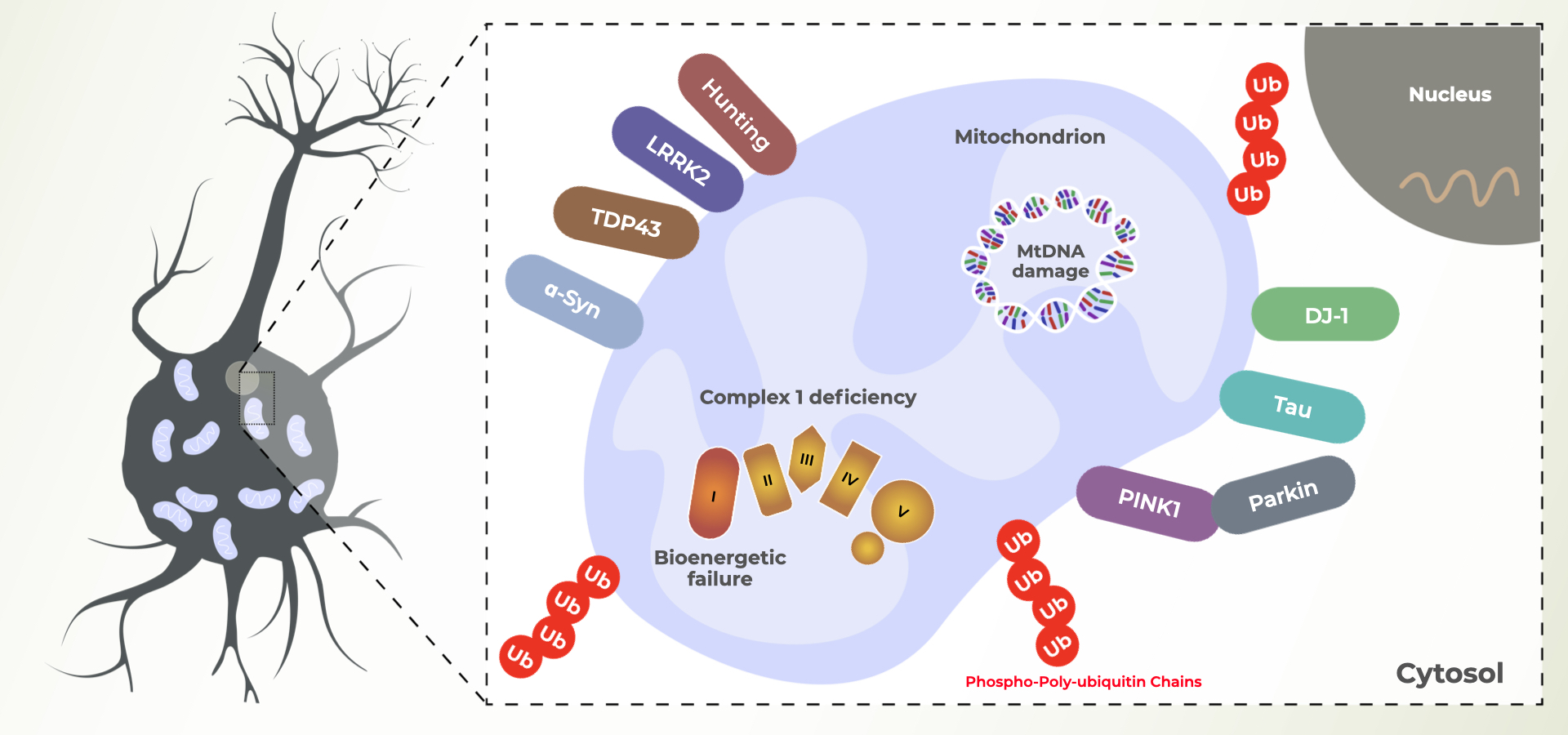
The Ubiquitin Proteasome System (UPS) is the guardian of the cell. It removes damaged proteins and organelles and keeps the intracellular protein traffic running smoothly. In both Parkinson’s Disease (PD) and Alzheimer’s Disease (AD) the accumulation of protein aggregates, such as α-synuclein and tau, depolarize mitochondria. Dysfunctional mitochondria and loss of ATP is the main cause of neuronal cell death. We believe that dysfunction in the UPS is the root cause of neurodegeneration. Novel and groundbreaking therapeutics are emerging by targeting the UPS. LifeSensors is at the forefront of neurodegeneration research and the discovery of neuronal biomarkers.
UPS
α-Syn
Tau
- Understanding Parkinson's Disease
The Ubiquitin Proteasome System (UPS) is the guardian of the cell. It removes damaged proteins and organelles and keeps the intracellular protein traffic running smoothly. In both Parkinson’s Disease (PD) and Alzheimer’s Disease (AD) the accumulation of protein aggregates, such as α-synuclein and tau, depolarize mitochondria.
Dysfunctional mitochondria and the resulting loss of ATP is the main cause of neuronal cell death. We believe that dysfunction in the UPS is the root cause of neurodegeneration. Novel and groundbreaking therapeutics are emerging by targeting the UPS. LifeSensors is at the forefront of neurodegeneration research and the discovery of neuronal biomarkers.
Key Research Focus Areas
- Protein aggregate formation and clearance mechanisms
- Mitochondrial dysfunction and oxidative stress
- UPS pathway dysregulation in neurodegeneration
- Novel therapeutic targeting strategies
- Biomarker identification and validation
Clinical Significance
Parkinson's Disease affects over 10 million people worldwide. Understanding the molecular mechanisms underlying in neurodegeneration is crucial for developing effective therapeutic interventions. The UPS plays a central role in maintaining cellular protein homeostasis, and its dysfunction is increasingly recognized as a key contributor to neurodegenerative pathology.
- PINK1 & Parkin: Key Players in Neuronal Health
PINK1 Kinase
PTEN-induced kinase 1 – Mitochondrial quality control sensor
- Stabilized on damaged mitochondria
- Phosphorylates ubiquitin molecules
- Initiates mitophagy cascade
- Critical for neuronal survival
Parkin E3 Ligase
- Recruited to damaged mitochondria
- Builds polyubiquitin chains
- Triggers autophagy pathways
- Mutations cause early-onset PD
- The Mechanism
When mitochondria are damaged, PINK1, a mitochondrial kinase, is stabilized to generate phospho-ubiquitin. Phospho-ubiquitin binds to Parkin, activating the cytosolic E3 ligase. Activated Parkin builds phospho-polyubiquitin chains to induce autophagy, mitophagy, and mitobiogenesis. Mitochondria exploit the UPS and Parkin to repair the damage. Mutations in PINK1 and Parkin lead to neurodegeneration. A remarkable series of experiments demonstrate that mitochondria conspire to recruit the UPS by phosphorylating ubiquitin by PINK1 kinase and jumpstarting Parkin ligase. Nature is elegant, the UPS needs ATP to function, and mitochondria needs the UPS to repair itself and prevent neurodegeneration.
Step-by-Step Molecular Pathway
- Mitochondrial Damage Detection
- Phospho-Ubiquitin Generation
- Parkin Recruitment & Activation
- Polyubiquitin Chain Assembly
Activated Parkin builds K63-linked polyubiquitin chains on mitochondrial substrates
- Mitophagy Induction
Polyubiquitinated mitochondria are recognized by autophagy receptors, triggering selective degradation
- Cellular Homeostasis Restoration
- Pathological Consequences
- Accumulation of damaged mitochondria
- Increased oxidative stress
- ATP depletion and energy crisis
- Progressive neuronal cell death
- Protective Mechanisms
- Efficient mitochondrial quality control
- Maintained cellular energy homeostasis
- Reduced oxidative damage
- Enhanced neuronal resilience
- LifeSensors Offers A New Suite of Neurodegeneration Tools
Phospho-ubiquitin Antibodies
High-affinity, validated antibodies for detecting and quantifying phosphorylated ubiquitin species
Phospho-ubiquitin Chains
Synthetic and recombinant phospho-ubiquitin chains and derivatives for mechanistic studies
Neuronal DUBs and Ligases
Deubiquitinases and E3 ligases critical for neuronal protein homeostasis
PINK1 and Parkin Pathway Proteins
Complete set of recombinant proteins for studying mitochondrial quality control
Enriched Lysates
Phospho-polyubiquitinated protein enriched lysates from neuronal sources
TUBEs
Tandem Ubiquitin Binding Entities for selective enrichment of ubiquitinated proteins
UbiQuant™ for Phospho-Polyubiquitination
- LifeSensors Offers Assays and Reagents for Neuroscience
PROTAC Approaches for Tauopathies and α-Synucleinopathies
PROteolysis TArgeting Chimeras (PROTACs) represent a revolutionary therapeutic strategy for selectively degrading disease-causing proteins. Our PROTAC platforms target pathological tau and α-synuclein aggregates, offering novel approaches to treating neurodegenerative diseases.
Research Services on E3 Ubiquitin Ligases
Comprehensive research services for characterizing E3 ligase function, substrate identification, and drug discovery. Our expert team provides custom assay development, screening services, and mechanistic studies.
Biomarker Development for Parkinson's Disease / Alzheimer's Disease
Advanced biomarker discovery and validation services focused on early detection and disease monitoring. Our platforms enable identification of novel diagnostic and prognostic markers for neurodegenerative diseases.
PD Research Products
Extensive catalog of specialized reagents, antibodies, proteins, and assay kits specifically designed for Parkinson's Disease research. All products are rigorously validated and quality controlled.
- LifeSensors is Leading the Search for Biomarkers
Phospho-ubiquitin is an alarm bell and a biomarker for neurodegeneration. LifeSensors has developed high affinity tools to enrich phospho-ubiquitin and phospho-Parkin from brain tissue, CSF, and serum. These tools can be applied for developing ultra-sensitive assays for biomarker development and diagnostic applications. LifeSensors has developed unique HTS (High-Throughput System) assays for discovering Parkin modulators. LifeSensors is also developing novel biomarkers for PD and AD.
- Featured Products
- NEW Neurodegeneration Tools & Products