Questions about a product, technology or experimental design? Give us a call 610-644-8845. For special institutional pricing, check out our Distributors!
Questions about a product, technology or experimental design? Give us a call 610-644-8845.

Novel Approaches to PROTAC® Drug Discovery

INTRODUCTION

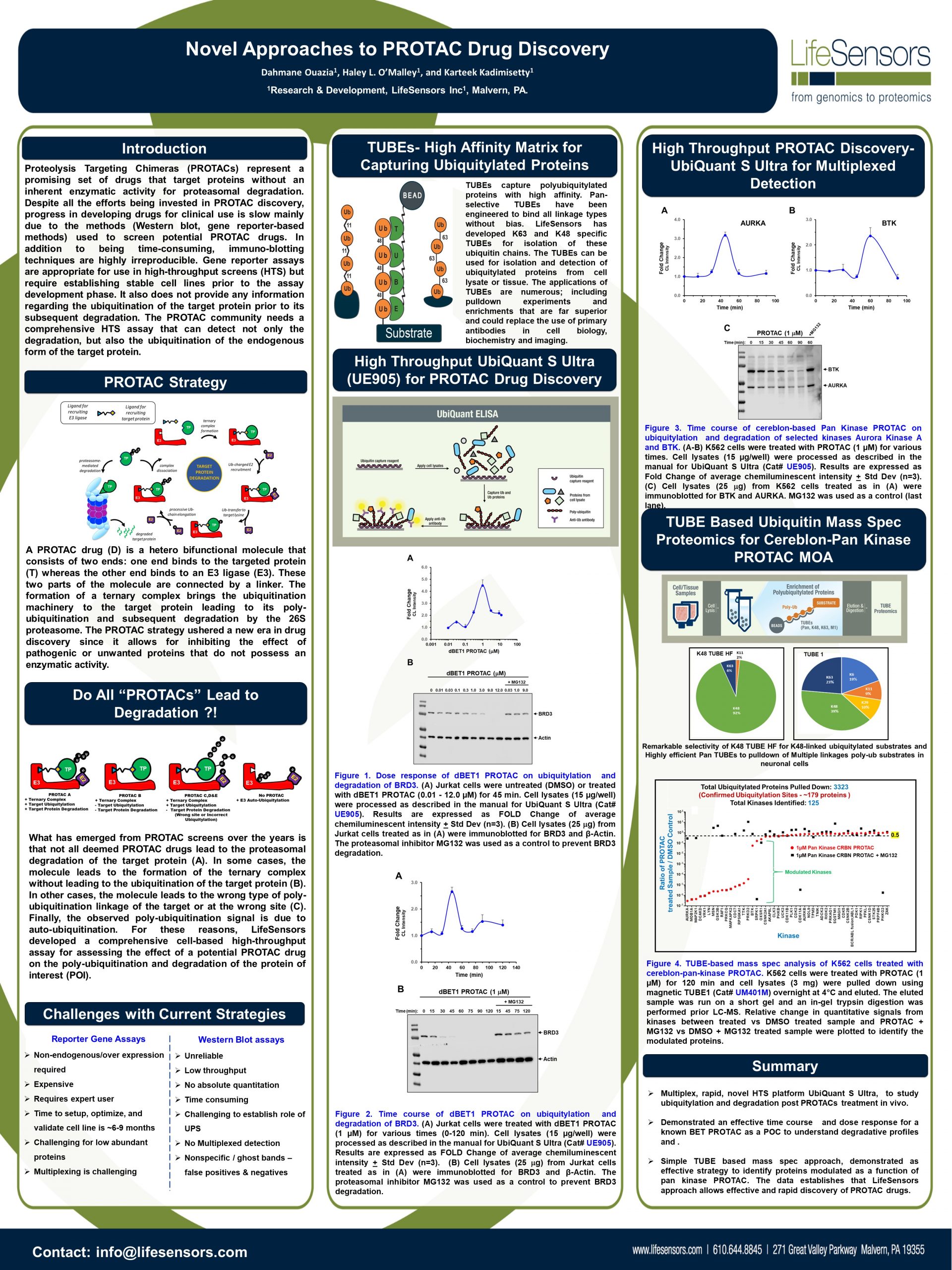
Proteolysis Targeting Chimeras (PROTACs) represent a promising set of drugs that target proteins without an inherent enzymatic activity for proteasomal degradation. Despite all the efforts being invested in PROTAC discovery, progress in developing drugs for clinical use is slow mainly due to the methods (Western blot, gene reporter-based methods) used to screen potential PROTAC drugs. In addition to being time-consuming, immuno-blotting techniques are highly irreproducible. Gene reporter assays are appropriate for use in high-throughput screens (HTS) but require establishing stable cell lines prior to the assay development phase. It also does not provide any information regarding the ubiquitination of the target protein prior to its subsequent degradation. The PROTAC community needs a comprehensive HTS assay that can detect not only the degradation, but also the ubiquitination of the endogenous form of the target protein.

Share this article:

Related Articles

With ubiquitin’s core functions in plants and animals being so similar it has long been speculated that insights into the

The functional consequences of protein polyubiquitination are determined by the type of ubiquitin chain assembled on the substrate. Among the

While direct K-RAS inhibitors represent a major therapeutic advance, targeting this oncoprotein remains a significant challenge due to limited druggable

Pan-selective Tandem Ubiquitin-Binding Entities (TUBEs) are engineered, high-affinity reagents composed of multiple ubiquitin-associated (UBA) domains that bind polyubiquitin chains with

LifeSensors is pleased to bring attention to some of our academic colleagues who have used our products in the past

Different lysines on ubiquitin are involved in forming different ubiquitin chains, with K48-linked chains primarily signaling for proteasomal degradation, while

With ubiquitin’s core functions in plants and animals being so similar it has long been speculated that insights into the

The functional consequences of protein polyubiquitination are determined by the type of ubiquitin chain assembled on the substrate. Among the

While direct K-RAS inhibitors represent a major therapeutic advance, targeting this oncoprotein remains a significant challenge due to limited druggable

Pan-selective Tandem Ubiquitin-Binding Entities (TUBEs) are engineered, high-affinity reagents composed of multiple ubiquitin-associated (UBA) domains that bind polyubiquitin chains with

LifeSensors is pleased to bring attention to some of our academic colleagues who have used our products in the past

Different lysines on ubiquitin are involved in forming different ubiquitin chains, with K48-linked chains primarily signaling for proteasomal degradation, while

Menu

Learning Center