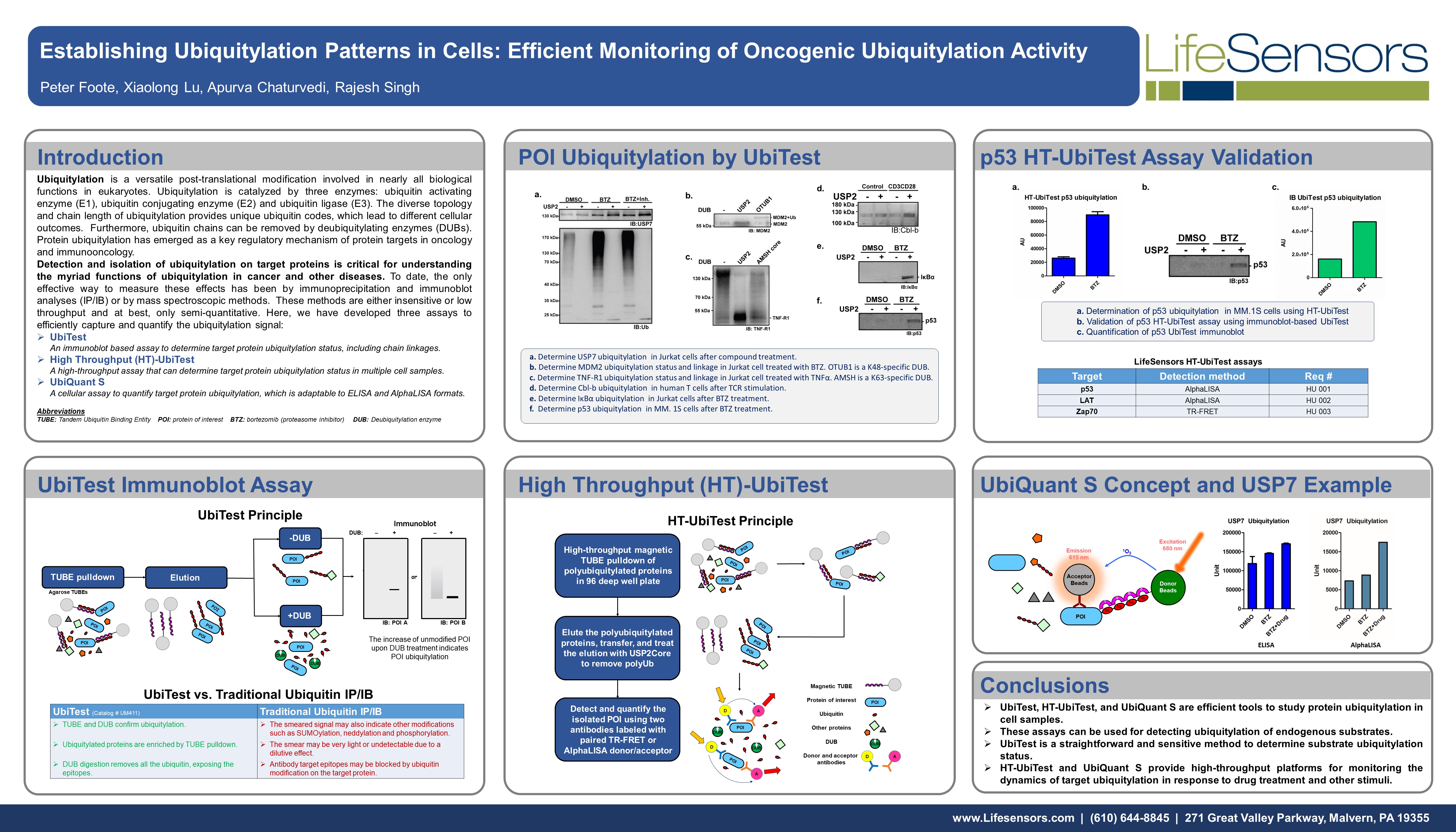
Lifesensors recently presented the work of Peter Foote, Xialong Lu, Apurva Chaturvedi, and Rajesh Singh at AACR2018. A PDF of this poster can be downloaded here.
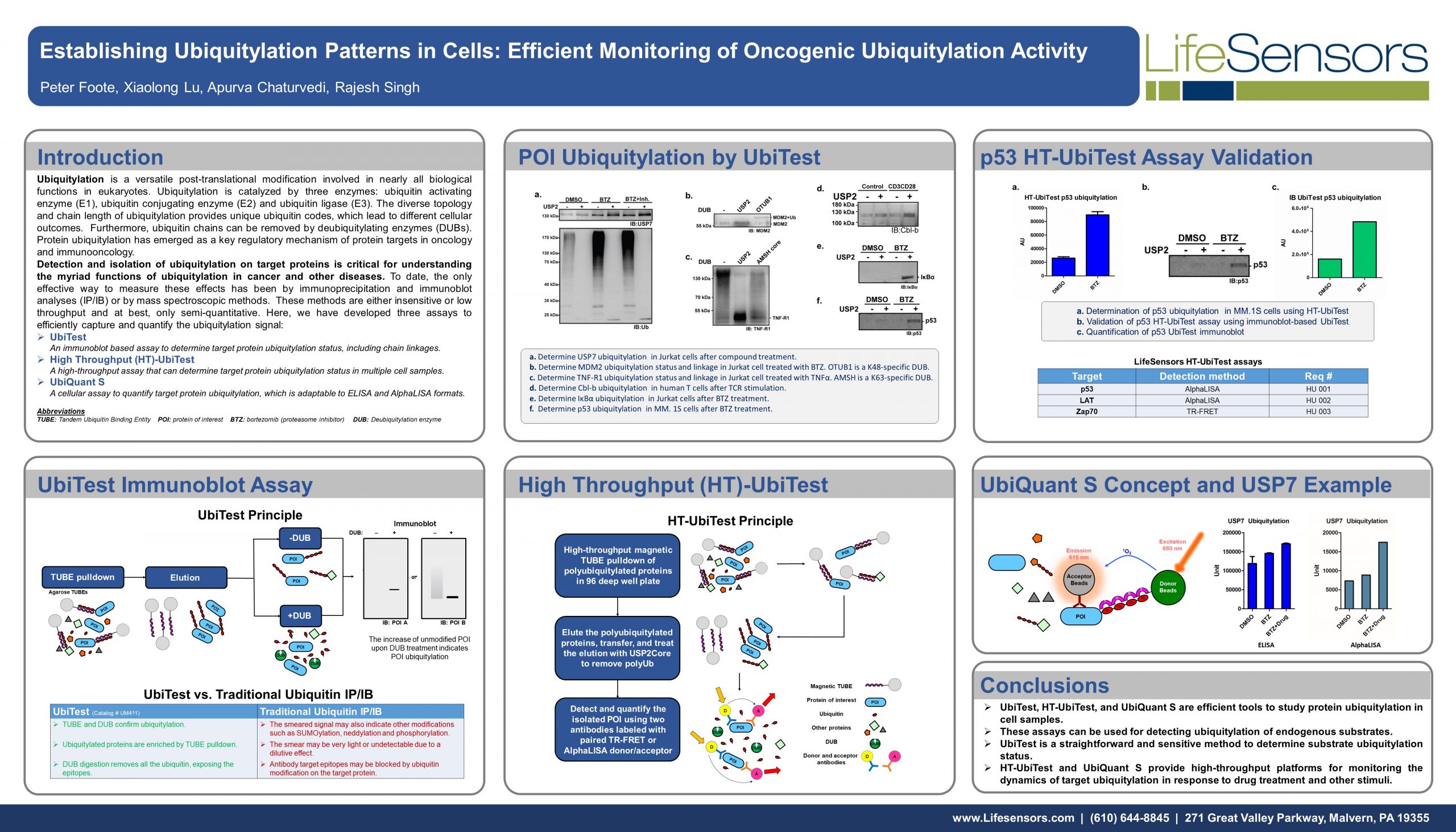
Ubiquitylation is a versatile post-translational modification involved in nearly all biological functions in eukaryotes. Ubiquitylation is catalyzed by three enzymes: ubiquitin activating enzyme (E1), ubiquitin conjugating enzyme (E2) and ubiquitin ligase (E3). The diverse topology and chain length of ubiquitylation provides unique ubiquitin codes, which lead to different cellular outcomes. Furthermore, ubiquitin chains can be removed by deubiquitylating enzymes (DUBs). Protein ubiquitylation has emerged as a key regulatory mechanism of protein targets in oncology and immunooncology.
Detection and isolation of ubiquitylation on target proteins is critical for understanding the myriad functions of ubiquitylation in cancer and other diseases. To date, the only effective way to measure these effects has been by immunoprecipitation and immunoblot analyses (IP/IB) or by mass spectroscopic methods. These methods are either insensitive or low throughput and at best, only semi-quantitative. Here, we have developed three assays to efficiently capture and quantify the ubiquitylation signal:
An immunoblot based assay to determine target protein ubiquitylation status, including chain linkages.
A high-throughput assay that can determine target protein ubiquitylation status in multiple cell samples.
A cellular assay to quantify target protein ubiquitylation, which is adaptable to ELISA and AlphaLISA formats.
Understanding an E3 ligase is an essential step for choosing a target for screening in the case of a molecular
With ubiquitin’s core functions in plants and animals being so similar it has long been speculated that insights into the
The functional consequences of protein polyubiquitination are determined by the type of ubiquitin chain assembled on the substrate. Among the
While direct K-RAS inhibitors represent a major therapeutic advance, targeting this oncoprotein remains a significant challenge due to limited druggable
Pan-selective Tandem Ubiquitin-Binding Entities (TUBEs) are engineered, high-affinity reagents composed of multiple ubiquitin-associated (UBA) domains that bind polyubiquitin chains with
LifeSensors is pleased to bring attention to some of our academic colleagues who have used our products in the past
Understanding an E3 ligase is an essential step for choosing a target for screening in the case of a molecular
With ubiquitin’s core functions in plants and animals being so similar it has long been speculated that insights into the
The functional consequences of protein polyubiquitination are determined by the type of ubiquitin chain assembled on the substrate. Among the
While direct K-RAS inhibitors represent a major therapeutic advance, targeting this oncoprotein remains a significant challenge due to limited druggable
Pan-selective Tandem Ubiquitin-Binding Entities (TUBEs) are engineered, high-affinity reagents composed of multiple ubiquitin-associated (UBA) domains that bind polyubiquitin chains with
LifeSensors is pleased to bring attention to some of our academic colleagues who have used our products in the past