
PROTAC® Drug Discovery
Advanced proteolysis-targeting solutions for next-generation drug discovery and development
Need Help?

- Overview

PROTACs (PROteolysis TArgeting Chimeras) artificially hijack the components of the UPS to degrade a target protein. PROTAC drugs are hetero-bifunctional small molecules that contain two functional ligands connected via a linker: one ligand binds to a target protein and the other ligand binds to an E3 ligase.
Bringing these two entities into proximity theoretically leads to polyubiquitylation and proteasomal degradation of the target protein. However, given the complexity, this scenario does not always play out, and the PROTAC discovery strategy faces several challenges and pitfalls.
Molecular Glues offer a similar benefit and mechanism of action but have a superior size and kinetics allowing for a potentially better drug with fewer off target effects.
Molecular glues, as opposed to PROTACs, require screening and pose a unique set of challenges from a developmental perspective.
Evaluate Molecular Glues
For further discovery of these smaller monovalent cousin of PROTACs
- Our Technology Platform
To address these challenges, LifeSensors developed high-throughput tools for monitoring both polyubiquitylation and degradation of a target protein. Measuring ubiquitylation of a protein in a plate-based format accelerates PROTAC-based drug discovery while also allowing rapid screening of molecular glues. Mass spec can be used for deeper exploration of the impact of a PROTAC drug candidate.
We have developed several platforms that enable rapid, quantitative monitoring of in vitro as well as cellular ubiquitylation.
High-Throughput
Quantitative
Versatile
- PROTAC® Services
PROTAC® Degradation Assays
Comprehensive degradation monitoring and analysis for your target proteins using our validated assay platforms.
PROTAC® Ubiquitination Assays
High-throughput ubiquitination monitoring to accelerate your PROTAC development pipeline.
Target Exploration & Validation
Identify and validate optimal protein targets for your therapeutic development programs.
Novel E3 Ligases for PROTAC® & Molecular Glues
Access our proprietary library of E3 ligases to expand your PROTAC design possibilities.
PROTAC® Ternary Complex Assays
Characterize and optimize ternary complex formation for improved PROTAC efficacy.
- PROTAC® Degradation Assays
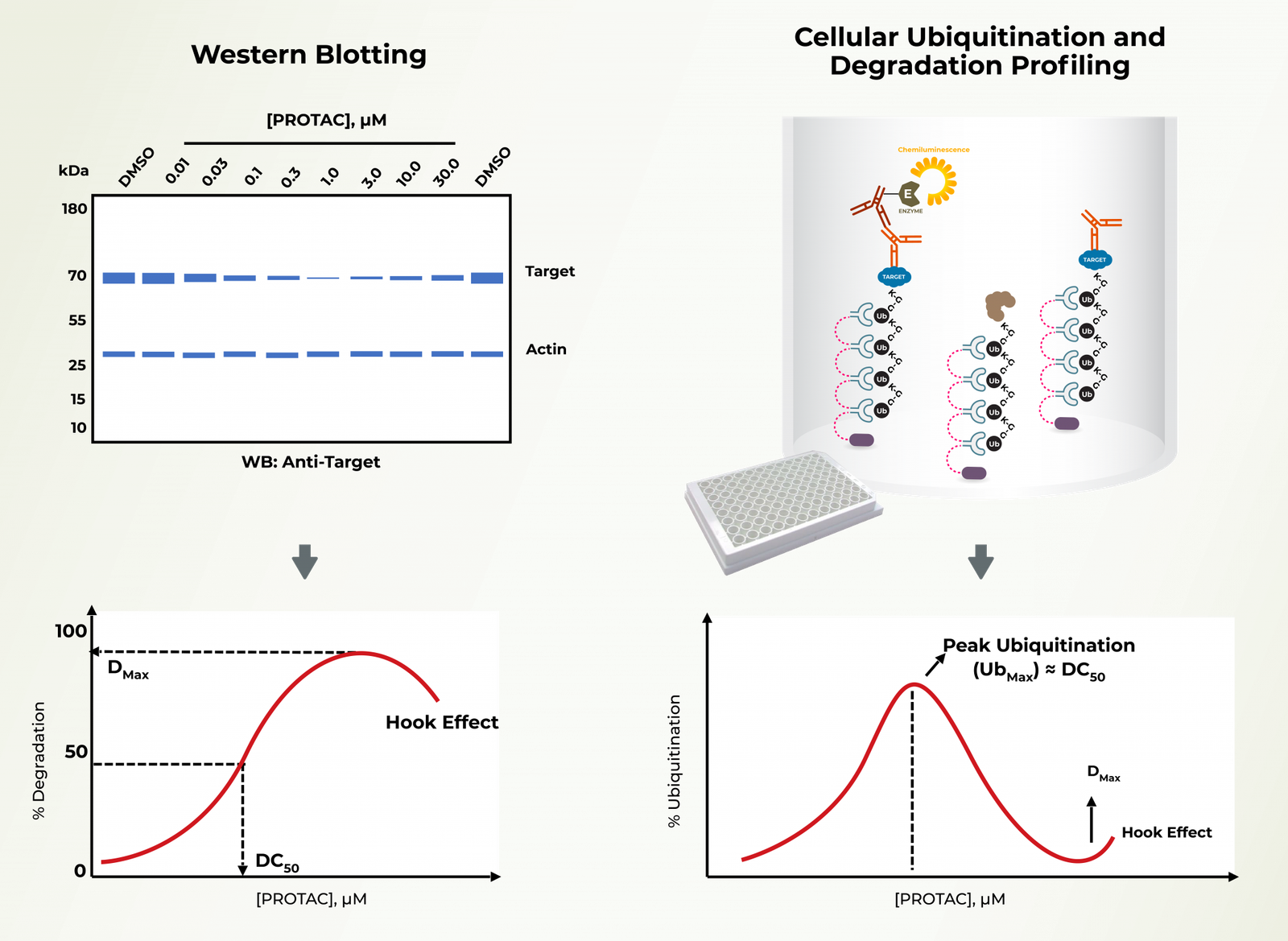
The PROTAC approach has shown great promise at degrading proteins that were previously deemed extremely difficult to target. Extending PROTAC technology to the undruggable proteome is hindered by a lack of efficient workflows to understand PROTAC structure–activity relationships.
LifeSensors offers a comprehensive evaluation of PROTAC-mediated ubiquitination and degradation using traditional western blotting, reporter gene assays (fluorescent proteins and HiBiT) and our high-throughput ubiquitination and degradation assays. Our targeted protein degradation team has a strong track record in developing preclinical PROTAC programs starting with identification of ligands for target, ligands for novel E3 ligases, designing model PROTACs, establishing ubiquitination, degradation, and lead optimization. During the optimization stage we offer collaboration with chemistry teams to rationally design a PROTAC that has superior ubiquitination and degradation profiles that can translate into reliable clinical candidates.
- PROTAC® Ubiquitination Assays
LifeSensors offers a comprehensive evaluation of PROTAC-mediated ubiquitination and degradation using customized assays.
Current PROTAC discovery heavily relies on monitoring the ternary complex formation using biophysical and biochemical approaches like TR-FRET proximity ligand assays and SPR, that do not monitor the true function of PROTAC-mediated ubiquitination.
Ubiquitination assays are critical to PROTAC design and discovery because they directly report on the mechanistic step that links target engagement to protein degradation. While PROTACs are designed to bind both a target protein and an E3 ligase, successful degradation ultimately depends on whether this induced proximity results in productive ubiquitin transfer. Ubiquitination assays therefore provide an essential readout beyond binary binding or ternary complex formation, confirming that a given PROTAC actually triggers E3-dependent ubiquitination of the target.
During PROTAC optimization, ubiquitination assays help differentiate productive from nonproductive ternary complexes, revealing how linker length, composition, and ligase choice influence ubiquitin chain formation and topology. These assays can quantify ubiquitination kinetics, chain type (e.g., K48 versus non-degradative linkages), and substrate specificity, all of which strongly impact downstream proteasomal degradation. Importantly, they also enable early detection of off-target ubiquitination, helping to de-risk candidates before advancing to cellular or in vivo studies.
By providing sensitive, quantitative insight into ubiquitin transfer, these assays guide rational optimization, improve predictability of cellular outcomes, and accelerate the identification of high-quality PROTAC leads.
Designing PROTACs that harness the protein’s intrinsic properties, such as exposed lysines that result in efficient ubiquitination, is crucial to develop potent degraders. Most current PROTACs utilize only a few E3 ligases, which ultimately hinders the vast expansion of the undruggable proteasome.
LifeSensors in vitro ubiquitination platform was designed to monitor multiple variants of PROTAC with variable linkerology, exit vectors, variable ligands for an E3 ligase, or targets to evaluate the best combination that results in robust ubiquitination. We offer collaboration with chemistry teams to rationally design PROTACs that have superior ubiquitination efficiency that can translate into superior degradation in vivo.


Monitor PROTAC® Activity
Monitor PROTAC activity by monitoring ubiquitination, with the target of your choice in HTS format
Establish Rank Order
Accurately establish rank order potencies to guide medicinal chemists for reliable SAR
Screen E3 Ligases
Screen for superior E3 ligases for novel targets based on ubiquitination potential
Discover Molecular Glues
Rationally discover and design molecular glues
- Target Exploration & Validation

Validation of a novel target’s ability to degrade with subsequent observation of the predicted phenotype is crucial for PROTAC drug discovery.
Our Approach
At LifeSensors, we offer a comprehensive overview of endogenous target protein expression, generate cell lines with a degrader tag (dTAG, BromoTAG®) on the target protein of interest. Selective degradation is induced with the tagged protein of interest that can define the role of the target in physiological function or a disease mechanism to produce a relevant phenotype.
Successful validation of a target followed by the design of a chemical modulator like PROTAC, is key in targeted protein degradation drug development so long as it can selectively modulate the endogenous target.
Target Expression Validation
Validate target expression levels in relevant cellular models for exploring TPD approach
Functional Validation
Validate role of target in physiological function and disease mechanism
Expert TPD Team
Dedicated TPD team with more than 20 years of experience in UPS related drug discovery
Comprehensive Analysis
End-to-end support from target validation to PROTAC design and optimization
- Novel E3 Ligases for PROTAC® & Molecular Glues

Identifying and leveraging novel E3 ligases is a major frontier in PROTAC design and discovery, as the choice of ligase strongly influences target scope, selectivity, and therapeutic potential. While early PROTACs predominantly relied on a small set of well-characterized ligases such as cereblon (CRBN) and VHL, the human genome encodes more than 600 E3 ligases, most of which remain underexplored for targeted degradation. Expanding the ligase toolbox enables access to new tissues, disease contexts, and target classes that may be poorly addressed by existing ligases.
From a design perspective, novel E3 ligases can offer distinct substrate recognition surfaces, ubiquitin chain preferences, and cellular expression patterns, all of which affect PROTAC efficacy and safety. Tissue- or cell-type–restricted ligases may enable more selective degradation and reduce on-target toxicity in healthy tissues, while ligases with unique ubiquitination kinetics may better accommodate certain targets or ternary complex geometries. However, developing PROTACs against new ligases presents challenges, including identifying suitable small-molecule ligands, understanding ligase biology, and validating that ligase recruitment leads to productive ubiquitination rather than nonfunctional complex formation.
Here, ubiquitination and substrate discovery assays play a central role. Biochemical assays can confirm that recruiting a novel E3 ligase results in target ubiquitination, while proteomics approaches can map substrate scope and identify unintended effects. Together, these tools enable systematic evaluation of emerging E3 ligases, helping to de-risk PROTAC programs and broaden the therapeutic reach of targeted protein degradation.
E3 Ligase Ligand Identification and Validation
Comprehensive screening and validation of novel E3 ligase ligands
PROTAC® Design & Productive Ternary Complex
Expert screening and optimization of ternary complex formation
PROTAC®-Mediated Target Ubiquitination
Validation of target protein ubiquitination efficiency
Degradation Assays
Comprehensive assessment of target protein degradation
Our Novel E3 ligases for PROTAC service includes high-throughput screening for identifying novel ligands, characterizing ligand affinity to novel E3 ligase, demonstrating selectivity, PROTAC design, and evaluating target degradation.
- PROTAC® Ternary Complex Assays
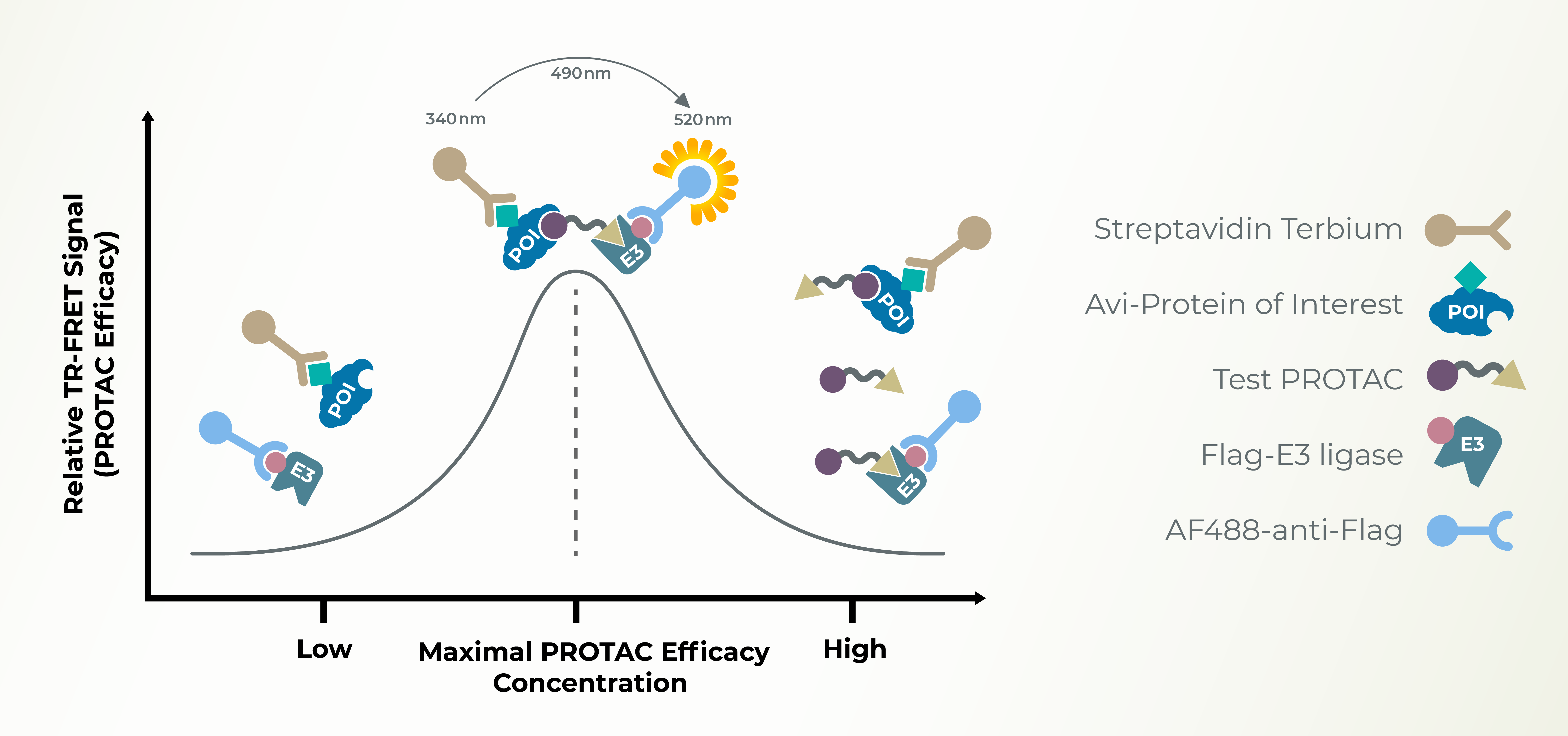
PROTACs (PROteolysis TArgeting Chimeras) are heterobifunctional molecules that combine a target-binding warhead with an E3 ligase-binding moiety, resulting in the formation of a ternary complex between the target protein and the E3 ligase to induce ubiquitination and degradation.
- Technology Background
It is increasingly clear that the length and composition of the linker connecting the two ligands plays a crucial role in the physiochemical properties and biological activity of PROTACs. The PROTAC field is rapidly evolving and is currently undergoing an important transition from synthetically manageable alkyl and polyethylene glycol linkers to more complex functional linkers.
Traditionally, ternary complex formation has been assessed using cell-free proximity ligand assays such as TR-FRET, ALPHA screening assays, and SPR-based methods.
Key Insight:
LifeSensors offers a wide array of services to validate PROTAC ternary complex, PROTAC ubiquitination and determining binding affinities (SPR).
Multiple Ranking Approaches
Multiple approaches to rank PROTAC variants
Fast & Sensitive
Rapid results with high sensitivity detection
Orthogonal Correlation
Correlate activity with orthogonal assays
Complex Evaluation
Evaluate relative population of ternary complexes and correlate with ubiquitination potential
Extensive E3 Ligase Access
Access to ~50 E3 ligases to study selectivity
Explore Our Applied Research
Discover the latest findings and innovations in PROTAC validation technology